
How Elderly Rehabilitation Helps Prevent Falls and Improve Confidence in Seniors
 by
by 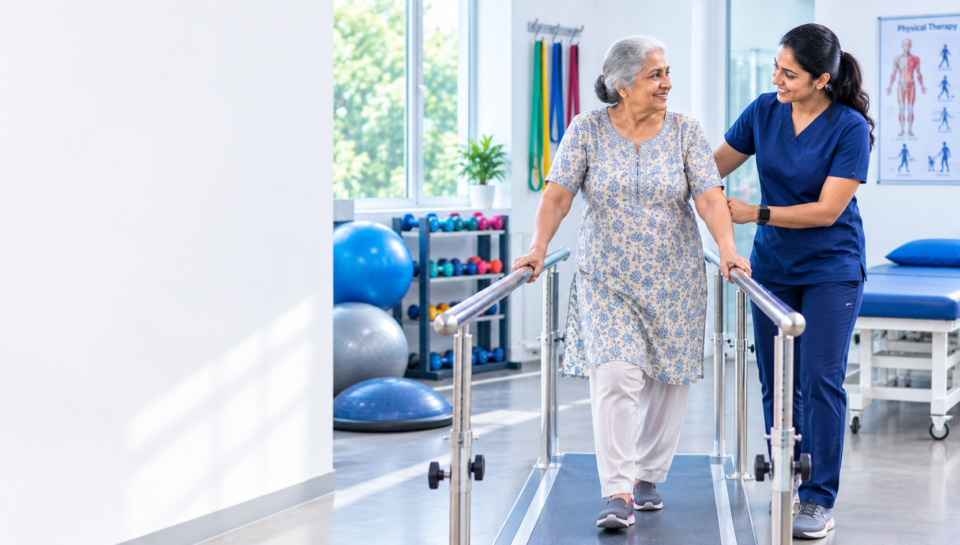
Falls are a common concern for older adults and their families. A fall can result in injuries, reduced mobility, fear of movement, and loss of independence. However, growing older does not mean that falls are unavoidable. Appropriate rehabilitation, regular physical activity, strength training, balance exercises, and a safer living environment can all contribute to better mobility and fall prevention. The World Health Organization recommends activities that emphasize balance and strength for older adults with poor mobility to help prevent falls.
Elderly rehabilitation can play an important role by identifying movement difficulties, improving physical function, and helping seniors feel more confident while walking and performing everyday activities.
At Book My Rehab, we believe that recovery is more than just healing it’s about regaining strength, restoring confidence, and getting back to the life you love. Whether you’re recovering from surgery, managing a sports injury, or living with a chronic condition, our expert team is here to support you every step of the way. Book My Rehab offers trusted physiotherapy and rehabilitation in Vasai, Virar, and Nalasopara, providing personalized care for pain relief, recovery, and better mobility through expert-led, evidence-based treatments.
Why Are Falls More Common in Older Adults?
Several physical and environmental factors can increase the risk of falling as people age. These may include reduced muscle strength, balance problems, slower reactions, limited mobility, vision difficulties, certain medical conditions, medication effects, and hazards within the home.
Reduced activity can also contribute to muscle weakness and deconditioning. When leg and core muscles become weaker, everyday movements such as standing from a chair, climbing stairs, or walking on uneven surfaces may become more difficult.
The good news is that many fall-risk factors can be addressed through appropriate assessment and rehabilitation.
What Is Elderly Rehabilitation?
Elderly rehabilitation is a personalized approach designed to help older adults maintain or regain physical function and independence.
Depending on an individual’s needs, rehabilitation may include:
- Strengthening exercises
- Balance training
- Walking and gait training
- Flexibility exercises
- Functional movement practice
- Posture training
- Mobility exercises
- Fall-prevention education
The exact program should be based on the person’s health, mobility, medical history, physical abilities, and goals.
How Elderly Rehabilitation Helps Prevent Falls
1. Improves Leg and Core Strength
Strong muscles are important for maintaining stability during everyday movements. Weakness in the legs can make it harder to stand, walk, climb stairs, or recover balance after an unexpected movement.
A physiotherapist can introduce progressive strengthening exercises appropriate for the individual’s ability. These may focus on the legs, hips, core, and other muscles involved in functional movement.
Strength and balance training are recognized components of effective fall-prevention strategies for older adults.
2. Improves Balance and Stability
Balance can be affected by aging, inactivity, neurological conditions, joint problems, or previous injuries.
Rehabilitation may include supervised activities that challenge balance safely, such as:
- Controlled weight shifting
- Supported standing
- Reaching exercises
- Step training
- Turning practice
- Functional balance activities
Exercises can be gradually progressed as the senior becomes more stable and confident.
3. Supports Better Walking Ability
Changes in walking patterns can increase fall risk. Some seniors may take shorter steps, walk more slowly, have difficulty lifting their feet, or struggle when changing direction.
Gait training helps patients practice safer walking patterns under professional supervision. Depending on the person’s condition, a physiotherapist may also assess whether a walking aid is appropriate and teach the patient how to use it safely.
4. Improves Mobility and Flexibility
Stiff joints and tight muscles can make normal movements more difficult. Limited hip, knee, or ankle mobility may affect walking and balance.
Appropriate mobility and flexibility exercises can help seniors move more comfortably and perform functional activities with greater ease.
5. Builds Confidence After a Fall
A previous fall can create a fear of falling again. This may cause a person to avoid walking or other activities, which can lead to further weakness and reduced physical capacity.
A gradual rehabilitation program gives seniors opportunities to practice movement safely. As they become more comfortable with standing, walking, and everyday activities, their confidence can improve.
Fall-prevention exercise programs can also help reduce fear of falling in older adults.
Elderly Rehabilitation and Independence
Preventing falls is not the only goal of rehabilitation. Maintaining independence is equally important.
A rehabilitation program may help seniors practice everyday tasks such as:
- Getting out of bed
- Standing from a chair
- Walking indoors and outdoors
- Using stairs
- Getting into and out of a vehicle
- Reaching for objects
- Moving around the kitchen
- Performing personal-care activities
These activities are often more meaningful than simply improving a strength score because they directly affect a person’s ability to live independently.
Home Safety Is Also Important
Exercise alone may not address every fall risk. The home environment should also be considered.
Common hazards can include:
- Loose rugs
- Poor lighting
- Cluttered walking areas
- Slippery bathroom surfaces
- Lack of handrails
- Unsuitable footwear
- Frequently used objects placed out of reach
WHO recommends home assessment and modifications as part of fall-prevention strategies for older adults.
Families can work with healthcare professionals to identify potential hazards and make appropriate changes.
When Should a Senior Consider Rehabilitation?
Rehabilitation may be worth considering if an older adult:
- Has fallen recently
- Feels unsteady while walking
- Has difficulty getting up from a chair
- Avoids stairs because of weakness or fear
- Has noticeable muscle weakness
- Has reduced walking endurance
- Uses a walking aid but feels unsafe with it
- Is recovering from surgery or hospitalization
- Has a neurological or orthopaedic condition affecting mobility
A professional assessment can help determine whether rehabilitation is appropriate and what type of support may be needed.
How Physiotherapists Personalize Elderly Rehabilitation
There is no single exercise program suitable for every senior. A physiotherapist may assess:
- Muscle strength
- Balance
- Walking pattern
- Joint mobility
- Coordination
- Posture
- Functional abilities
- Previous falls
- Activity level
Based on the assessment, the therapist can develop a progressive program and modify it as the person’s abilities improve.
For older adults with limited mobility, WHO recommends physical activity that emphasizes balance and fall prevention on three or more days per week, while activity levels should be adapted to individual abilities and health conditions.
Why Consistency Matters
Rehabilitation is most effective when appropriate exercises and movement habits are practiced consistently. Seniors should not feel pressured to make rapid progress. Recovery and physical conditioning should develop gradually.
Family members can support consistency by encouraging seniors to follow their prescribed exercise program, attend rehabilitation sessions, and remain appropriately active.
At the same time, exercises should not be performed independently when there is a significant fall risk unless a healthcare professional has confirmed that they are safe.
Why Choose Book My Rehab for Elderly Rehabilitation?
Book My Rehab provides personalized physiotherapy and rehabilitation services in Vasai, Virar, and Nalasopara.
Our approach focuses on helping seniors improve mobility, strength, balance, and functional independence through expert-led, evidence-based rehabilitation. Treatment is adapted to individual needs rather than relying on a one-size-fits-all exercise routine.
Whether a senior is recovering after an injury, dealing with age-related mobility changes, or trying to regain confidence after a fall, appropriate rehabilitation can provide structured support throughout the recovery journey.
Conclusion
Falls can have a significant impact on an older adult’s physical health, confidence, and independence. However, appropriate intervention can help address many factors associated with fall risk.
Elderly rehabilitation combines strength training, balance exercises, mobility work, gait training, functional activities, and fall-prevention education to help seniors move more safely and confidently. Evidence-based fall-prevention strategies particularly emphasize combinations of balance, strength, gait, and functional training.
At Book My Rehab, the focus is not simply on preventing falls. It is about helping seniors maintain the strength and confidence needed to participate in everyday life. With personalized rehabilitation, professional guidance, and appropriate support at home, older adults can work toward better mobility, greater independence, and an improved quality of life.
Frequently Asked Questions
1. Can elderly rehabilitation prevent falls?
Rehabilitation can help address several modifiable fall-risk factors, including poor balance, muscle weakness, reduced mobility, and walking difficulties. Fall prevention may also require home-safety changes and medical review where appropriate.
2. What exercises are useful for elderly fall prevention?
Depending on the individual’s condition, rehabilitation may include balance, strength, gait, flexibility, and functional exercises. A physiotherapist can recommend appropriate exercises after assessment.
3. Can rehabilitation improve confidence after a fall?
Yes. Gradual, supervised practice can help seniors become more comfortable with movement and everyday activities. This may help reduce fear of falling.
4. Is elderly rehabilitation suitable for seniors with limited mobility?
Yes. Rehabilitation can be adapted to a person’s current abilities. Exercises may begin with supported or seated activities and progress gradually.
5. How often should seniors exercise for fall prevention?
WHO recommends that older adults with poor mobility include physical activity that enhances balance and helps prevent falls on three or more days per week, while activities should be adapted to individual health and ability.
6. Can physiotherapy help seniors walk better?
Yes. Physiotherapy can address strength, balance, joint mobility, coordination, and gait-related difficulties to support safer and more functional walking.
7. When should a senior see a physiotherapist after a fall?
A senior should consider professional assessment after a fall, particularly if they have pain, weakness, difficulty walking, repeated falls, or fear of falling. Serious injuries or sudden neurological symptoms require prompt medical evaluation.
8. Where is elderly rehabilitation available in Nalasopara?
Book My Rehab provides personalized physiotherapy and rehabilitation services in Nalasopara, as well as Vasai and Virar, with programs focused on mobility, strength, balance, and functional independence.